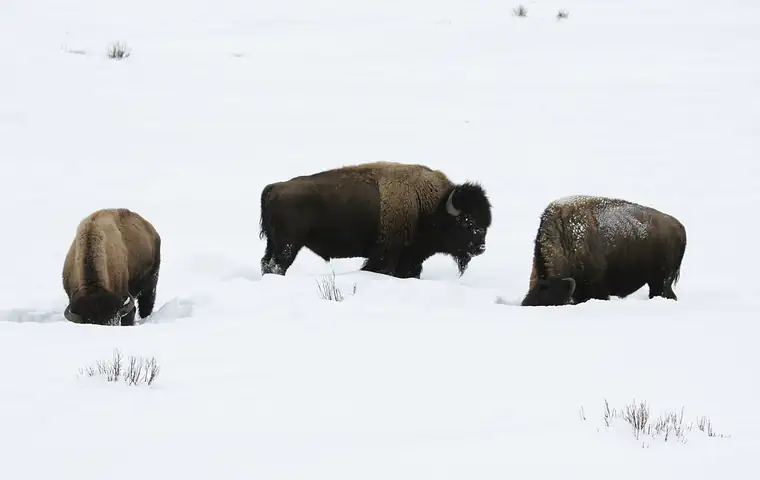
Taxonomy and Subspecies
The American bison belongs to genus Bison, family Bovidae, and is one of only two living bison species worldwide (the other being the European wisent, Bison bonasus). Two subspecies of American bison are recognised by most authorities:
- Plains bison (Bison bison bison): The more numerous and widely known subspecies. Historically ranged across the Great Plains from northern Canada to Texas. Slightly smaller and lighter than wood bison, with a more rounded hump profile and wool that tends to curl more tightly.
- Wood bison (Bison bison athabascae): The larger subspecies, historically found in the boreal forests and parklands of Canada and Alaska. Wood bison have a taller, squarer hump, a less woolly coat, a beard that is tufted rather than flowing, and on average outweigh plains bison by 100-180 kg. The subspecies was thought nearly extinct by the early 20th century, but a remnant population of around 200 animals was discovered in northern Alberta in 1957 and has since been partially recovered.
A third proposed subspecies, the eastern bison (Bison bison pennsylvanicus), was historically described from populations east of the Appalachians, but this designation is contested and most modern authorities do not recognise it, as the genetic distinction is unclear from the remaining evidence.
Physical Characteristics
The American bison is the largest land animal in North America. Adult bulls stand 170-200 cm (5.5-6.5 feet) at the shoulder hump and weigh 630-1,000 kg (1,390-2,200 lb). Exceptional bulls have been recorded at over 1,100 kg. Cows are considerably smaller: typically 360-544 kg (790-1,200 lb) and 152-180 cm at the shoulder.
Despite their bulk, bison are surprisingly agile. They can run at sustained speeds of 55-60 km/h (34-37 mph) and are capable of pivoting quickly and jumping fences. The National Park Service notes that bison have gored and injured more visitors at Yellowstone than any other animal, a direct result of their deceptively relaxed appearance.
Bison are seasonal breeders. Calves are born April through June after a gestation of approximately 285 days (9.5 months). Calves weigh 14-20 kg at birth and are capable of standing and running within hours. They nurse for 7-8 months. A bison cow typically produces her first calf at age 2-3 and can continue calving into her late teens. Lifespan in the wild is 15-20 years; in captivity up to 25 years.
Historical Population and the Great Slaughter
Before European contact, an estimated 30-60 million bison roamed North America, representing one of the largest aggregations of large mammals on Earth. The animals ranged from northern Canada and Alaska south to Mexico, and from the Rocky Mountains east to the Atlantic seaboard in lower densities. The centre of abundance was the Great Plains: modern Montana, Wyoming, the Dakotas, Kansas, Nebraska, Colorado, and Texas.
The collapse began with the expansion of commercial hide hunting in the 1870s. By the early 1870s, professional hunters with heavy-calibre rifles could kill 50-100 animals per day at a single stand, with the carcasses left to rot after the hide was taken. The Southern herd was essentially eliminated by 1878; the Northern herd by 1883. By 1889, a survey by the Smithsonian Institution's William Hornaday could locate only 1,091 bison remaining in North America: 256 in wild populations and the rest in captivity or on private ranches.
The slaughter was not purely commercial. There was deliberate policy intent: eliminating the bison undermined the food base and cultural foundation of Plains Indian nations who had organised their entire way of life around the herds. General Philip Sheridan told the Texas legislature in 1875 that the hunters "have done more to settle the vexed Indian question than the entire regular army has done in the last thirty years." The bison's near-extinction was thus inseparable from the displacement of Indigenous peoples from their ancestral lands.
Recovery: A Conservation Success Story
The recovery of the American bison is one of conservation's genuine success stories, though it comes with significant caveats about genetic integrity and ecological function.
The foundation of the recovery was a small group of private ranchers and early conservationists. Charles "Buffalo" Jones, rancher Samuel Walking Coyote (Pend d'Oreilles), Charles Goodnight in Texas, and the Allard family in Montana maintained private herds through the 1880s and 1890s. These animals, along with zoo specimens, formed the genetic basis of all subsequent recovery efforts.
Yellowstone National Park held the only continuously wild population (never extirpated), numbering just 23 animals in 1902. A federal programme of transfers and protection built this to around 4,900 animals by 2021. The Yellowstone herd is considered the most genetically "pure" free-ranging population because it was never crossed with domestic cattle.
By 2016, the American bison was designated the United States national mammal by the National Bison Legacy Act. The current North American population is estimated at 430,000-530,000 animals, though most of these (roughly 400,000) are in commercial ranch herds managed for meat production. Only 20,000-30,000 are in conservation herds managed primarily for ecological and genetic purposes.
The Cattle Hybridisation Problem
The most significant long-term conservation challenge is not population size but genetic integrity. Most bison alive today carry some domestic cattle (Bos taurus) ancestry from historical interbreeding experiments in the late 19th and early 20th centuries, when ranchers crossed bison with cattle hoping for a "beefalo" that combined bison hardiness with cattle productivity.
A 2010 study by the National Park Service and University of California Davis found that of the 11 major federal bison conservation herds examined, only the Yellowstone and Henry Mountains (Utah) herds showed no detectable cattle ancestry. Wind Cave National Park's herd showed a low level of cattle introgression. Most other herds had measurable cattle mtDNA.
This matters because the "pure" bison genome may encode adaptations (cold tolerance, foraging behaviour, disease resistance) that the cattle-hybridised genome has partially lost. Conservationists debate whether hybridisation significantly affects ecological function or whether the practical priority should be expanding range and herd sizes regardless of genetic purity.
Ecology and Role on the Plains
Bison are keystone species on the Great Plains. Their grazing creates habitat heterogeneity: heavily grazed patches interspersed with taller ungrazed grass support higher overall plant and invertebrate biodiversity than uniformly grazed grassland. Their wallowing behaviour, rolling in dust and mud in shallow depressions, creates distinctive "bison wallows" that collect water and support specialist plant communities.
Bison also transport nutrients across the landscape in their dung (averaging 12-14 kg of dung per day in large bulls) and through their migratory movements, which historically covered hundreds of kilometres seasonally. Their trampling and grazing stimulates grass tillering and maintains the short-grass and mixed-grass prairie types that much of the American West's biodiversity depends on.
The removal of bison from the plains was a principal driver of the widespread conversion of native grassland to agriculture; without large grazers, the ecological processes that maintained native plant diversity were disrupted. Restoration ecologists increasingly view bison reintroduction as a priority tool for prairie restoration, not just wildlife spectacle.
Current IUCN Status
The American bison is listed as Near Threatened on the IUCN Red List (assessed 2017). The listing acknowledges population recovery while noting that no wild, free-ranging, ecologically functioning population of sufficient size to be self-sustaining over the long term currently exists. The largest semi-wild herd (Yellowstone, ~5,000) is ecologically bounded by human-managed boundaries and periodic culling.
The IUCN identifies the primary threats as: small effective population sizes with limited genetic interchange between herds; lack of free-roaming space; cattle hybridisation in most herds; disease transmission (brucellosis, bovine tuberculosis) at the interface with cattle ranching; and insufficient political will to establish large, truly wild populations.