- Wood Buffalo NP~5,000
- Elk Island NP~700
- Theodore Roosevelt NP~600
- Yellowstone NP~5,000
- Wind Cave / Custer~1,700
- Antelope Island~700
Schematic map: the historic-range boundary and herd positions are approximate and for orientation only, not drawn to survey precision. Herd sizes are the site-canonical figures from the range table below. There is no free-ranging, unfenced wild population today; every significant herd is managed within boundaries.
The Geographic Argument
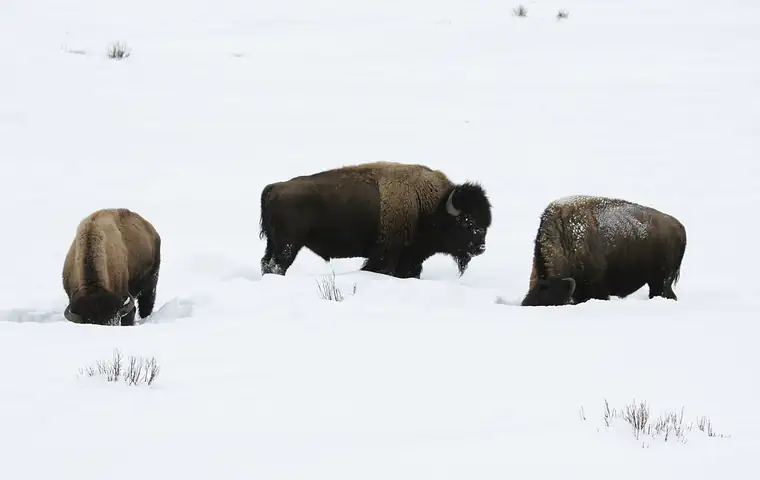
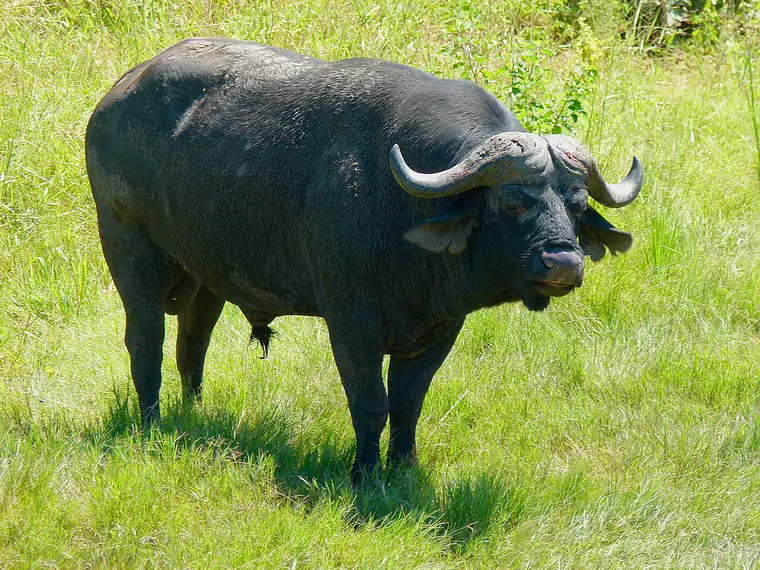
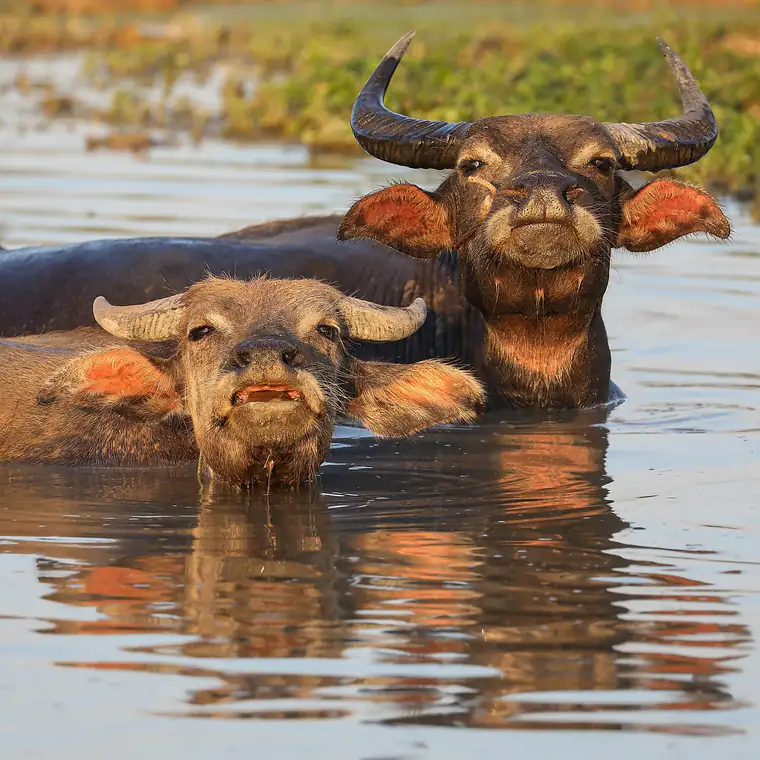
Perhaps the simplest way to resolve the bison vs buffalo question is geographic: if the large bovid you are looking at is in North America, it is a bison (or a domestic cow). If it is in Africa, it is a cape buffalo. If it is working in rice paddies or grazing on Asian grasslands, it is a water buffalo.
These ranges have never historically overlapped in the wild. The Atlantic and Pacific oceans, the absence of a land bridge between Africa/Asia and the Americas for tens of millions of years, and the profound climatic differences between the Great Plains, the African savanna, and the Asian monsoon zone all mean that these species evolved in complete isolation from each other.
The naming confusion is therefore doubly ironic: not only are bison and buffalo unrelated enough to never interbreed, they have never even co-existed in the same ecosystem. When European colonists called North American bison "buffalo," they were applying the name of an animal from a different continent to an animal that had never shared a range with it.
North America
American bison
Bison bison
Europe
European wisent
Bison bonasus
Sub-Saharan Africa
Cape buffalo
Syncerus caffer
South & SE Asia
Wild water buffalo
Bubalus arnee
American Bison (Bison bison)
IUCN: Near ThreatenedEuropean Wisent (Bison bonasus)
IUCN: Near ThreatenedCape Buffalo (Syncerus caffer)
IUCN: Near Threatened (declining)Wild Water Buffalo (Bubalus arnee)
IUCN: EndangeredWhy Ranges Have Contracted
The story of range contraction is different for each species, but share common drivers:
- American bison: Commercial hide hunting in the 1870s-1880s eliminated the species from virtually its entire range within a decade. Current range is entirely determined by management decisions, not natural processes.
- European wisent: Progressive hunting pressure over centuries, accelerated by World War I military activities in the Bialowieza Forest (1915-17) and subsequent poaching. Wild extinction in 1927. Current range is entirely the result of deliberate reintroduction from zoo populations.
- Cape buffalo: Agriculture and settlement have reduced and fragmented habitat. Disease (particularly rinderpest pandemic in the late 19th century, which killed an estimated 80-90% of Eastern and Southern Africa's buffalo) caused massive historical losses. Populations recovered after rinderpest eradication but face ongoing pressure from foot-and-mouth disease, bovine tuberculosis, and hunting.
- Wild water buffalo: Agriculture (especially wet rice expansion), human settlement of floodplains, hunting, and (crucially) hybridisation with domestic buffalo have eliminated wild populations across most of former range. The separation of truly wild from feral-domestic animals is now a serious scientific challenge.
Overlap with Introduced/Feral Populations
Outside their native ranges, both bison and buffalo exist in various introduced and feral contexts:
- Feral bison: Small feral herds exist in parts of Alaska (Farewell, where a small herd was introduced in the 1920s) and Canada. Henry Island in British Columbia has had a small introduced population since 1993.
- Feral water buffalo: Large feral populations exist in Australia (Northern Territory, where they were introduced in the 19th century as work animals). The Australian population peaked at 300,000+ in the 1970s and was substantially culled in the 1980s-90s; current population is around 150,000 and managed as a pest species under the Brucellosis and Tuberculosis Eradication Campaign.
- Domestic water buffalo: Widespread globally on farms, from Italy (where buffalo mozzarella is produced) to Brazil, Egypt, and beyond. These farm populations do not represent wild range expansion.