1. The Shoulder Hump
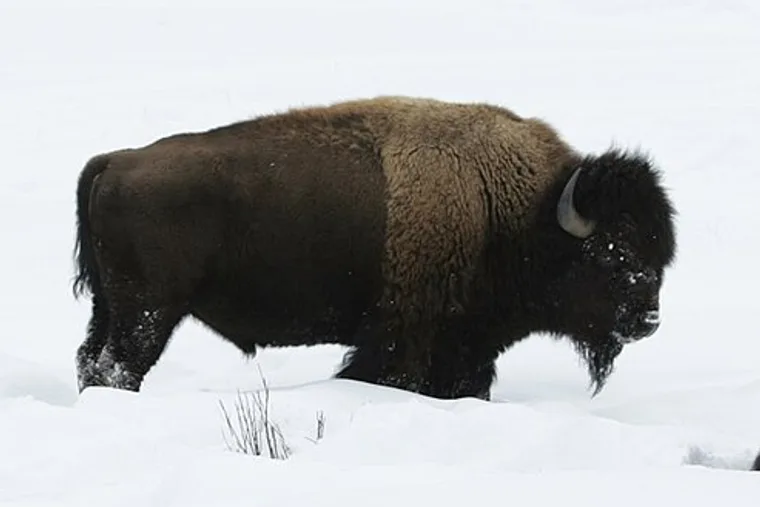
The most immediately visible feature of a bison is its pronounced muscular hump above the front shoulders. This hump is composed of elongated vertebral spines (the neural spines of the thoracic vertebrae can measure up to 53 cm / 21 inches in large bulls) and the heavy musculature that supports the enormous head during foraging. In a healthy adult bison, the hump can rise 15-25 cm above the shoulder blade, giving the animal its distinctive front-heavy silhouette.
No true buffalo, neither cape nor water, possesses this structure. African cape buffalo have a slight ridge at the shoulder at most, and water buffalo are notably flat-backed across the topline. If you see a large bovid with an obvious, rounded hump rising behind the neck, you are looking at a bison (or possibly a zebu cattle if in a farming context, but zebu humps sit further forward).
The hump is present in both male and female bison, though it is more pronounced in bulls. Even bison calves, which are born a distinctive red-orange colour, develop a visible hump within their first few weeks of life. This is perhaps the single fastest identification shortcut in the field.
2. Horn Shape and Size
All three species have horns, but the horns differ so dramatically that they serve as a near-infallible identifier once you learn the pattern.
Bison horns are relatively short (typically 40-60 cm / 16-24 inches along the outer curve in bulls) and grow outward and upward from the skull in a gentle C-curve. They are set wide apart, pointing outward before curving inward at the tips. Both males and females carry horns, though bulls are noticeably heavier. The overall impression is of a modest, compact set of horns that look almost understated on such a large skull.
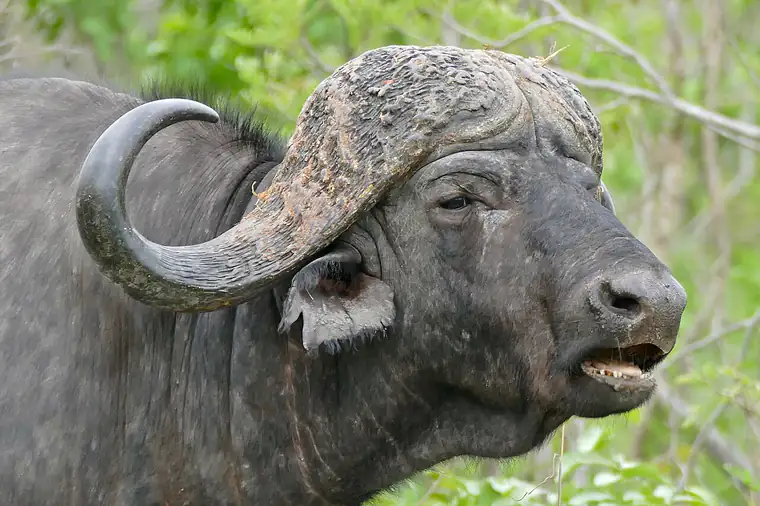
Cape buffalo horns are the diagnostic feature of the species. In adult bulls the horns form a continuous heavy shield of bone (called the "boss") across the forehead, fusing together at the base. From there the horns sweep downward and outward, then curve sharply upward and often inward at the tips. Mature bull horn spreads frequently reach 100-140 cm (39-55 inches) tip to tip, and record specimens exceed 160 cm. The boss itself can be 50 mm thick at the midline. Female cape buffalo lack the fused boss; their horns are thinner and less swept.
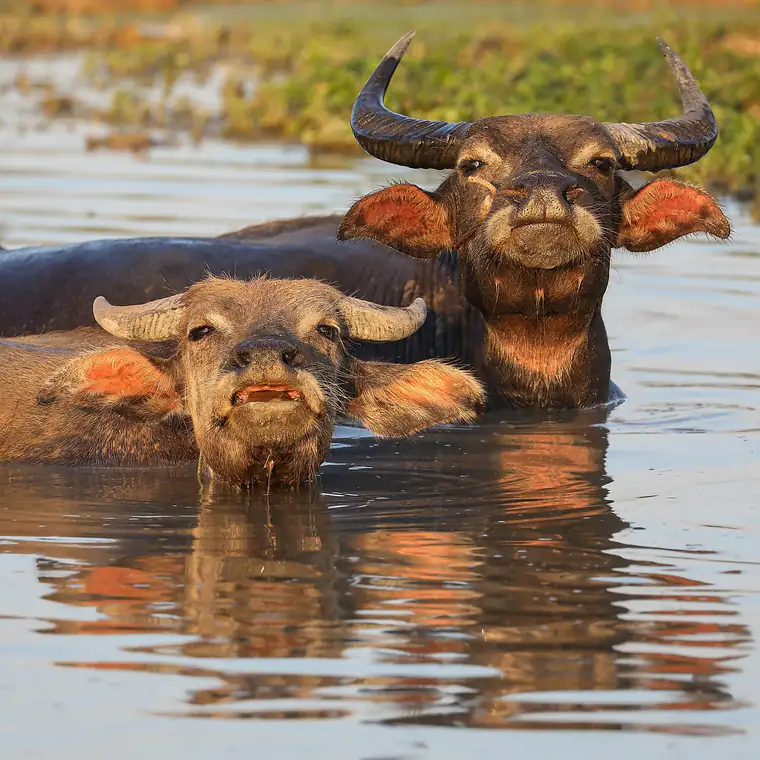
Water buffalo horns are long and crescent-shaped, sweeping backward and upward in a wide arc. Wild water buffalo bulls can have horn spans of 200+ cm (6.5 feet), the longest of any living bovid. Domestic water buffalo have been selectively bred and many have shorter, more variable horn shapes.
3. Beard, Mane and Coat Texture
American bison wear what can only be described as a winter coat year-round on their forequarters. The front half of the body (head, neck, shoulders, and forelimbs) is covered in thick, shaggy, curly hair that can reach 20-30 cm in length on the head and chin. This creates a distinctive "mane" and a proper beard hanging from the chin and throat. The beard is present in both sexes but is more developed in bulls.
The rear half of the bison is covered in shorter, finer hair, giving the animal a strongly two-toned appearance: dense and dark in front, lighter and smoother behind. This asymmetry is unique among the large bovids and is immediately obvious even at considerable distance.
Cape buffalo have comparatively sparse hair: a thin, dark coat (adult bulls are often nearly hairless on the face and upper neck from rubbing and wallowing) with no mane or beard. Their skin shows through in patches, giving older animals a somewhat mangy appearance. Young cape buffalo calves are reddish-brown, but adults are a dark charcoal grey to black.
Water buffalo have similarly sparse, bristly grey-black hair. Domestic water buffalo are occasionally partly albino or piebald. Neither species grows anything resembling the bison's facial mane.
4. Head Position and Size
Bison carry an extraordinarily large head that accounts for roughly a third of their total body length. More strikingly, the head hangs low, often level with or below the shoulder line when the animal is relaxed. This pendulous head carriage is a foraging adaptation: bison are well-designed to sweep their massive skull from side to side to clear snow from grass in winter, using their broad muzzle as a plow.
The skull itself is elongated and narrow in profile, with small eyes set far back and a very wide, blunt muzzle. The overall impression from the side is of a heavy, drooping triangle.
Cape buffalo hold their heads higher, roughly in line with the shoulder or slightly above. The skull is wide and flattened (especially in bulls, where the fused horn boss creates a helmet-like top to the head). Water buffalo also carry their heads relatively high, with a long, narrow skull profile.
5. Body Proportion and Stance
Bison are strikingly front-heavy. The shoulders (via the hump) are the highest point on the body, and the hindquarters taper down noticeably from there. When a bison walks, this gives the impression of a rolling, front-weighted gait. Their legs are relatively short for their mass, and the animals appear squatter and wider than a comparably sized cape buffalo.
Cape buffalo have a more uniform topline and appear more "square" in body proportions. Their legs are heavier-boned relative to body size than a bison's. Water buffalo are notable for their long, spreading hooves (an adaptation to soft and swampy ground) and their generally more slender build compared to a cape buffalo of similar mass.
The Five Features, Drawn
Both animals in profile, on the same ground line and drawn to the same relative scale against the figures on our size and weight page. The dashed line runs at rump height on each animal, which is the quickest way to see what the hump is actually doing. This diagram is ours, with no licence attached: reuse it with a link back.
- 1Shoulder hump. Elongated thoracic vertebrae carry a block of muscle over the front shoulders. Calves have it within weeks of birth.
- 2Beard. A thick fringe of hair hangs from the chin and throat, part of a shaggy cape across the whole forequarter.
- 3Short horns, curving up. Forty to sixty centimetres on a bull, rising from either side of the skull. They never fuse.
- 4Head carried low. Often level with or below the shoulder line, which is what lets a bison sweep snow off grass.
- 1Fused boss. A continuous shield of bone across the forehead of a mature bull. No bison grows one.
- 2Horns sweep down, then up. They drop away from the boss, out to the sides, and hook up at the tips. Spread reaches 100 to 140 cm. Side on that sweep points at you, so the head-on inset shows it properly.
- 3Level back. No hump at all. The topline runs flat from withers to rump, which the dashed line follows.
- 4Sparse coat, no beard. Thin slate-black hair, often worn bare on the face of an old bull. Nothing hangs from the chin.
Drawn for BisonVsBuffalo.com. Shoulder heights are to relative scale against the figures on our size and weight page, and both animals stand on the same ground line. The dashed line runs at rump height on each animal, so the hump rises above it on the bison and the topline sits along it on the buffalo. Our own drawing, no licence attached: reuse it with a link back if it is useful to you.
Summary: Four-Second Field Test
| What you see | Species |
|---|---|
| Visible shoulder hump + shaggy front half + short horns | American bison (or European wisent) |
| Helmet of fused horn above forehead + dark bare skin + no hump | African cape buffalo |
| Long crescent-sweeping horns + grey coat + Asian/farm context | Water buffalo |
| Small horns, domestic context, North American farm | Possibly bison-cattle hybrid (beefalo) or domestic cattle |
What About the European Wisent?
The European bison (Bison bonasus), also called wisent, is the American bison's closest living relative and the largest wild land mammal native to Europe. Like its American cousin, it has a hump, a shaggy front coat, and the same characteristic low-slung head carriage. European wisent are slightly taller and more lightly built than American plains bison, with a less pronounced hump and lighter forequarter coat. They are found in protected reserves in Poland (Bialowieza Forest), Belarus, and parts of Russia after being hunted to extinction in the wild by 1927 and successfully reintroduced from zoo populations.
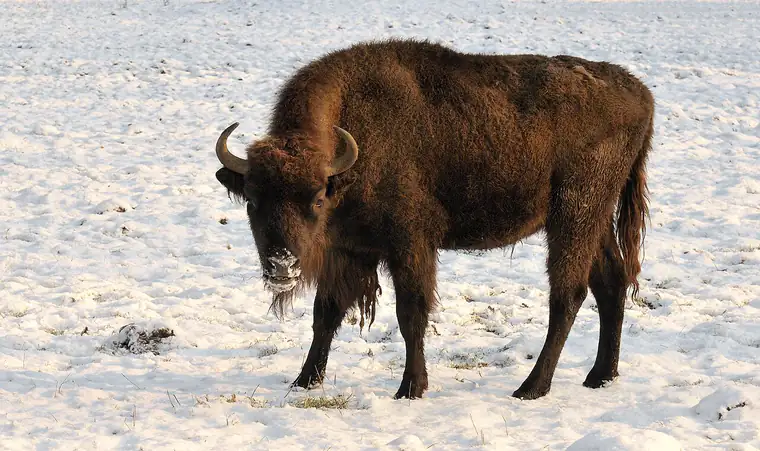
From a practical identification standpoint: if you are in Europe and see what looks like a bison, it is a wisent. If you are in North America, it is an American bison.
Genetic Relationship
Despite sharing a family (Bovidae) and even a tribe (Bovini) with the true buffalo, bison are more closely related to domestic cattle than they are to cape or water buffalo. Bison and domestic cattle (Bos taurus) diverged from a common ancestor approximately 1-2 million years ago, and they can interbreed to produce fertile offspring: "beefalo" or "cattalo." Bison and cape buffalo, by contrast, last shared a common ancestor roughly 5-9 million years ago and cannot interbreed.
This genetic reality reinforces the naming problem: the animal that Americans call "buffalo" is more a cattle relative than a buffalo relative. Taxonomists have been clear on this since the 19th century; popular usage simply never caught up.