Taxonomy: Wild vs Domestic
The taxonomy of water buffalo is more complex than for bison or cape buffalo. The current consensus recognises:
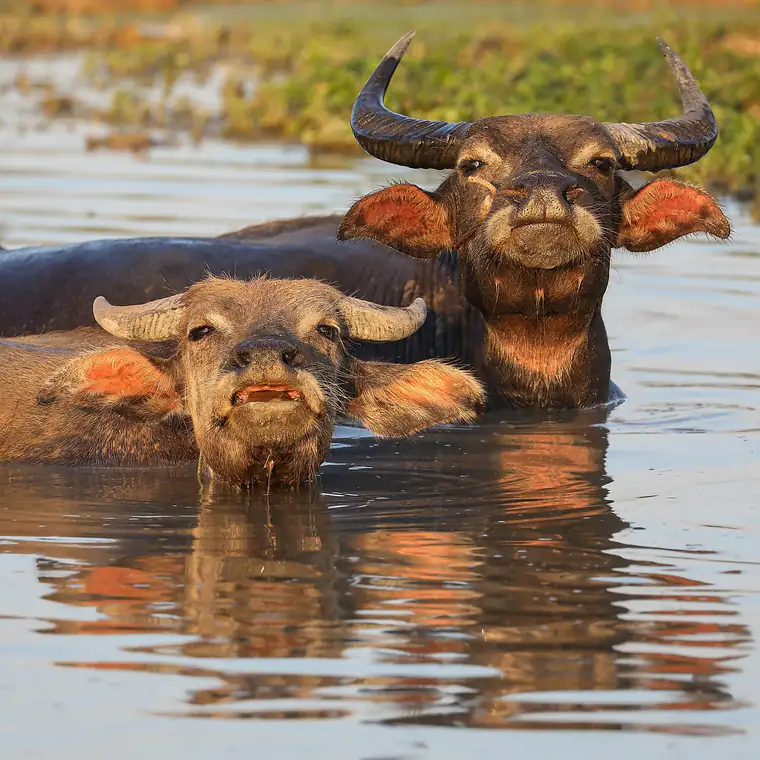
- Wild water buffalo (Bubalus arnee or Bubalus bubalis arnee): The wild ancestor. Listed as Endangered on the IUCN Red List with a declining population. Found in remnant populations in India (primarily Kaziranga and Manas National Parks in Assam), Nepal (Koshi Tappu Wildlife Reserve), Bhutan, Thailand and Cambodia, with an unconfirmed population in Myanmar. Extinct in Bangladesh, Laos, Vietnam and Sri Lanka.
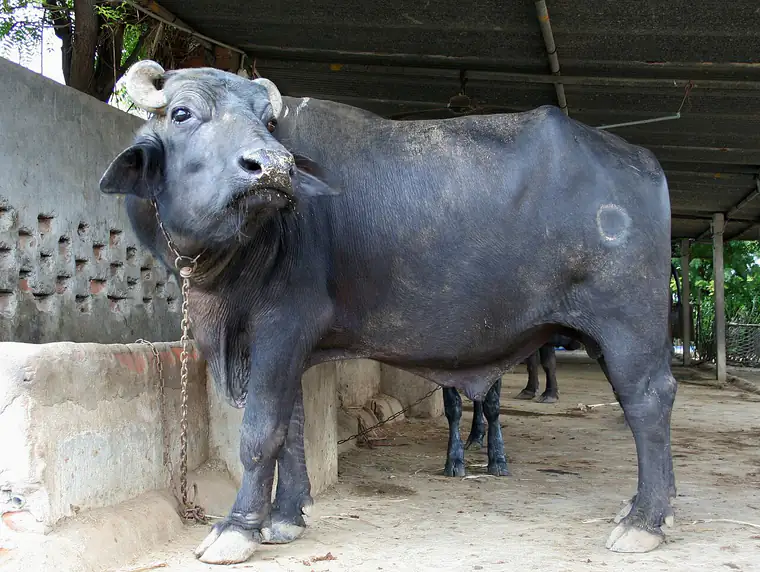
- Domestic water buffalo (Bubalus bubalis bubalis): Descends from the same wild ancestor, domesticated independently in at least two regions (South Asia and Southeast Asia/China) at least 3,000 years ago, possibly as early as 5,000 years ago. Domestic buffalo have been introduced worldwide and now range from India to Italy, Brazil to Australia.
Some authorities treat wild and domestic as a single species (Bubalus bubalis) with subspecies; others elevate the wild population to full species status (Bubalus arnee). The IUCN Red List treats the wild population as a separate taxon from the domestic form. This guide uses the distinction between "wild" and "domestic" throughout, as it is the practically meaningful distinction.
Physical Characteristics
Wild water buffalo are among the largest wild bovids on Earth. Bulls stand 150-190 cm (5-6.2 feet) at the shoulder and weigh 700-1,200 kg (1,540-2,640 lb); exceptional individuals may exceed 1,200 kg. Cows are smaller at 400-900 kg. Body length reaches 240-300 cm in large bulls.
The horns of wild water buffalo are the longest of any living bovid. They sweep backward and upward in a wide crescent arc; the world record wild specimen measured 4.24 metres (13.9 feet) along the outer curve. Even average bulls carry horn spreads of 100-180 cm. Domestic breeds have been selected for shorter, more manageable horns, but the crescent sweep is retained in many breeds.
The coat is sparse, grey-black to dark brown, with comparatively little hair on the body. The legs often have greyish-white stockings. The feet have large, wide-spreading hooves that provide flotation in muddy, wet ground, a direct adaptation to the wetland and floodplain habitats the species evolved in.
Gestation is approximately 300-340 days. Calves are born singly and are reddish-brown at birth. Lifespan in the wild is approximately 25 years; domestic buffalo can live 25-30 years.
Domestication History
Water buffalo domestication is one of the oldest and most consequential livestock stories in Asian history. Archaeological evidence from the Indus Valley civilisation (modern Pakistan) and from sites in China's Yangtze River basin suggests domestication as early as 3000-3500 BCE, possibly independently in both regions.
Unlike cattle or pigs, water buffalo were domesticated primarily as draft animals rather than for meat or milk. Their immense strength, stamina in hot and humid conditions, and ability to work in waterlogged paddy fields made them irreplaceable in wet rice cultivation, the agricultural system that fed the majority of Asia's growing population for millennia.
A pair of water buffalo could plough or puddle rice paddies that would be inaccessible to horses or zebu cattle. They can work for long hours in knee-deep water and consume coarse, low-quality forage that would be nutritionally inadequate for cattle. Their milk, while produced in smaller volumes than dairy cattle, is richer in fat (7-8% fat vs 3.5-4% in Holstein cows) and protein, making it valuable for buffalo mozzarella, butter, and ghee.
There are two primary domestic breeds/types:
- River buffalo: Found from India westward to the Balkans and Italy. Selected for milk production. The Murrah breed of Punjab is the world's highest-producing buffalo dairy breed. The famous Italian Mozzarella di Bufala Campana (protected designation of origin) is made from river buffalo milk.
- Swamp buffalo: Found from Assam eastward through Southeast Asia and into southern China. Selected for draft power rather than milk. Smaller, stockier, with wider horns that sweep more horizontally.
Total domestic water buffalo population: approximately 200-210 million animals worldwide (FAO data, 2022), with the largest populations in India (~108 million), Pakistan (~42 million), China (~25 million), and Nepal (~5 million). Italy's population is approximately 300,000, entirely managed for cheese production.
Wild Population Crisis
The wild water buffalo is one of Asia's most threatened large mammals. The IUCN Red List (2019 assessment) estimates a mature wild population of fewer than 4,000 individuals and notes a continuing decline. The species qualifies as Endangered under criterion C (small and declining population) and criterion D (restricted distribution).
The principal threats are:
- Hybridisation with domestic buffalo: This is considered the most severe threat. Wild buffalo freely interbreed with feral domestic animals in all range countries, diluting the wild genotype. As a result, some animals counted as wild carry recent domestic ancestry. The Kaziranga population (India) is considered the most genetically intact but even there, some domestic introgression has been documented.
- Habitat loss: The alluvial grasslands and floodplain forests of South and Southeast Asia are among the most heavily converted biomes in the world, driven by rice cultivation, human settlement, and infrastructure.
- Disease: Foot-and-mouth disease and other livestock diseases spread from domestic buffalo and cattle into wild populations.
- Hunting: For meat and horns; wild buffalo are still poached across their range despite legal protection.
A global action plan was developed by the IUCN for the wild water buffalo, calling for establishment of secure, disease-free, cattle-free sanctuaries where genetically pure wild buffalo can be maintained and studied. Progress has been slow. Koshi Tappu Wildlife Reserve in Nepal and Kaziranga National Park in Assam remain the most important current strongholds.