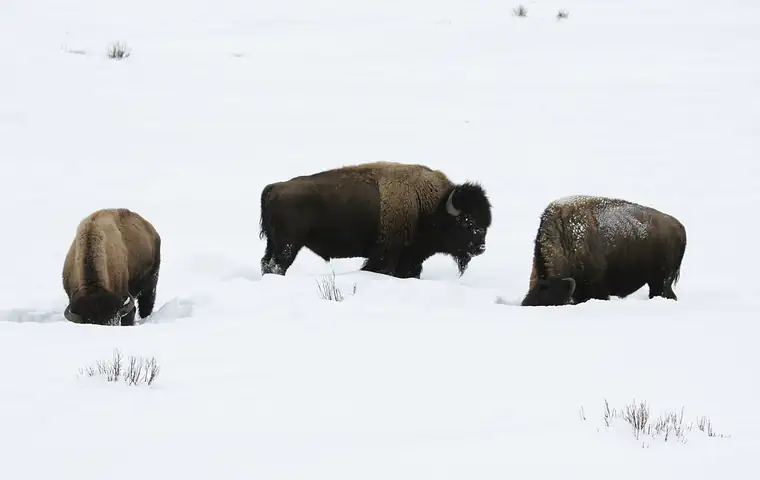
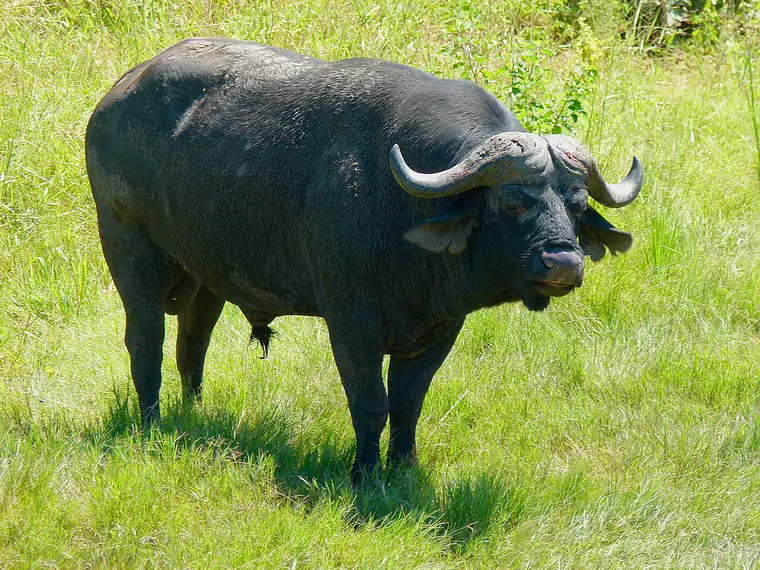
Why do Americans call bison "buffalo"?
Because the name got there first. When 17th-century French and English fur traders reached North America, they had no English word for the huge grazing animal of the plains, so they reused "buffalo" (from the French boeufs and buffelo), the name already applied to the large bovids of Africa and Asia. The word was the standard English name for the animal in colonial America by the late 1600s. Carl Linnaeus did not publish Systema Naturae until 1735, and Charles Hamilton Smith did not erect the genus Bison until 1827. The name beat binomial taxonomy to the animal by roughly 130 to 150 years, and beat the genus by about two hundred. It is a 400-year-old name, not a 400-year-old mistake. Both words survive: "buffalo" in everyday American English, "bison" where scientific or international precision matters.
Where the Word "Buffalo" Comes From
The English word "buffalo" derives from the Portuguese bufalo and Italian bufalo, which themselves come from the Late Latin bufalus, a variant of Classical Latin bubalus. The Latin word referred to an African wild ox, most likely what we now call the cape buffalo or possibly the North African wild ass. The root is connected to the Greek boubalos, which similarly referred to an African bovid or antelope.
Portuguese and Spanish explorers in the 15th and 16th centuries applied variations of "bufalo" to large bovids they encountered in Africa and Asia. The term was used loosely: any large, ox-like animal encountered by European travellers was a candidate for the label, regardless of actual taxonomic relationship.
Naming the Animal in Colonial North America
When French explorers and fur traders arrived in North America in the early 17th century and encountered the vast herds of Bison on the Great Plains and in the eastern woodlands, they needed a name for the unfamiliar animal. The most commonly cited early French usage is les boeufs (the oxen or cattle), but traders also used the term buffeloor buffle in the sense of "large horned animal" they had used for African and Asian bovids.
English colonists in eastern North America were familiar with the word "buffelo" through travellers' accounts of Africa and Asia, and they applied it to the unfamiliar animal they encountered in North America. An early record appears in the English naturalist John Lederer's 1670 account of his exploration of Virginia and the Carolinas, where he refers to seeing "Buffaloes." By the late 17th century, "buffalo" was the standard English name for the animal in colonial America.
This was naming by analogy, which is how almost every animal name in English was made. The animal resembled what travellers had described as a "buffalo" in its size, its herd behaviour, and its bovid anatomy, and no prior English word for the species existed, so the nearest cognate from the Old World was used. It is worth being precise about what those traders could and could not have known. Binomial taxonomy did not exist yet: Carl Linnaeus published the first edition of Systema Naturae in 1735, a full lifetime after "buffalo" was in routine colonial use, and the genus Bison was not erected until 1827. There was no classification for the name to be wrong about.
That ordering matters, and this site used to get it wrong. Calling "buffalo" a 400-year-old error implies that somebody blundered in the 1600s against a standard that would not be invented for another century. What actually happened is more interesting: a working name arrived first, a formal system arrived later, and the two have coexisted ever since.
When Scientists Disagreed
The formal scientific description of the American bison came in 1827 when naturalist Charles Hamilton Smith assigned the species to the genus Bison, establishing the name Bison bison. The genus name "Bison" had been in use in scientific literature since the 18th century: the term was borrowed from Latin writers who used bisonto refer to the European wisent.
From the moment of formal naming, scientists knew that the North American animal was a "bison" in the taxonomic sense, not a "buffalo." But scientific naming conventions have never had the power to overrule colloquial usage, especially usage that was already entrenched across an entire continent. By 1827, the word "buffalo" had been applied to the animal in North America for 150 years; it appeared in place names, songs, and everyday speech.
There is also historical debate about whether scientists aggressively promoted "bison" to replace "buffalo." The evidence suggests they largely did not: naturalists used "bison" in formal scientific writing but often used "buffalo" in popular accounts. William Hornaday's 1889 report "The Extermination of the American Bison" (which arguably launched the conservation movement for the species) uses both terms interchangeably.
Why the Name Never Changed
Several factors cemented "buffalo" in American English beyond recovery:
- Geographic names: By the mid-19th century, "buffalo" was embedded in hundreds of place names across the continent: Buffalo, New York (established 1813); Buffalo, Wyoming; Buffalo Bill (William Cody, 1846-1917); the Buffalo River; Buffalo Bayou in Texas; Buffalo Gap; Buffalo Soldiers. Renaming these would have required an impossible cultural effort.
- Cultural entrenchment: "Buffalo" was the name in every folk song, military report, treaty, and commercial document. "Home on the Range" (ca. 1872) refers to "where the buffalo roam." "Oh! Susanna" references "buffalo gals." The national consciousness had absorbed the word entirely.
- The Buffalo nickel: The Buffalo nickel, minted 1913-1938, depicted an American bison on the reverse and an Indigenous American on the obverse. The coin's popular name "Buffalo nickel" (rather than "Bison nickel") reflects the irreversibility of the folk name by the early 20th century.
- Lack of a competing vernacular: "Bison" was perceived as a technical, scientific term rather than a natural English word. In everyday speech, "buffalo" was simply more natural to American ears.
The National Bison Legacy Act (2016)
In 2016, President Barack Obama signed the National Bison Legacy Act, designating the American bison as the national mammal of the United States. The law uses the word "bison" throughout, which some conservationists saw as a quiet federal endorsement of the correct scientific name.
The act itself acknowledges the cultural history: it notes that the bison "is a historical symbol of the United States" and references the animal's significance to Indigenous peoples while using the scientifically accurate name. The Department of the Interior's National Park Service has used "bison" in its official communications since at least the 1990s, though even its own publications still use "buffalo" in historical contexts.
Is It Wrong to Say "Buffalo"?
In practice, using "buffalo" to refer to American bison is not a factual error in everyday speech; it is simply the established American English vernacular for the animal. Language does not operate by scientific taxonomy; it operates by usage. The Merriam-Webster Dictionary lists "buffalo" with its primary definition as the American bison. So does the American Heritage Dictionary.
However, in any context where precision matters (wildlife management, conservation biology, wildlife tourism, or international communication), "bison" is the clearer and more accurate term. An African wildlife guide who heard "buffalo" would assume you meant Syncerus caffer, not Bison bison. In international scientific and conservation contexts, "bison" and "buffalo" refer to genuinely different animals, and conflating them causes real confusion.
There is also a reason to be careful about calling the word an error outright. Many tribal nations use "buffalo" by choice, in English, for an animal central to their cultures and their ceremonies. The InterTribal Buffalo Council, founded in 1992 and now supported by more than seventy nations managing over 20,000 animals on tribal land, carries the word in its name. Declaring "buffalo" a mistake tells those communities they have the wrong word for their own relative. The honest position is narrower and easier to defend: "buffalo" is the older English name and a perfectly good one, and "bison" is the term that avoids ambiguity when you are talking to a biologist or to anyone outside North America. More on that in cultural significance.
The short answer: call it whatever you want in casual conversation, but if you want to be understood globally and scientifically, say "bison."
Other Languages Never Had the Problem
The double meaning is almost entirely an English-language phenomenon:
- French: bison for the American/European bison; bufflefor cape buffalo and water buffalo. The distinction is maintained.
- German: Bison for the American bison; Wisent for the European bison; Bueffel for buffalo. No naming confusion.
- Spanish: bisonte for bison (both species); bufalofor buffalo. Distinct.
- Russian: bizon (American bison) vs zubr (European wisent) vs buivol (buffalo). Entirely separate words.
The overlap is specific to English-language North America, where the colonial name had two centuries to settle before scientific nomenclature arrived with a competing one. In French, German, Spanish and Russian the two animals were named separately from the start, so there was never anything to reconcile.
Bison Is Not the Only Animal Whose Name Ignores Its Taxonomy
Treat "buffalo" as a uniquely American blunder and you have to explain away most of the continent's wildlife vocabulary. Common names record what people saw and what words they already had. They are not attempts at classification, and they are not graded against one.
- Pronghorn. Universally called an antelope across the American West, and it is not one. Antilocapra americana is the only surviving member of the family Antilocapridae, and its closest living relatives are giraffes and the okapi, not the antelopes of Africa and Asia.
- Prairie dog. Not a dog and not remotely canine. The five species of Cynomys are ground squirrels, in the same family as chipmunks and marmots. The name comes from the barking alarm call that early settlers heard across the plains.
- Moose and elk. The clearest case of all, because English contradicts itself across an ocean. The animal Americans call a moose is Alces alces, the same species Europeans call elk, Swedes call alg and Germans call Elch. In North America "elk" was reassigned to the wapiti, Cervus canadensis, a different animal in a different genus. Neither usage is an error; they are two speech communities that settled on different words.
- Groundhog, mountain goat, jackrabbit. No pig, no goat, no rabbit. The groundhog is a marmot, the mountain goat sits in Oreamnos rather than Capra, and the jackrabbit is a hare.
The same logic runs through the animals this site compares. A yak is not a buffalo either, and nobody calls that a scandal. See the four-way comparison of bison, both buffalo and the yak for where each one actually sits, and the bison versus elk page for the elk and wapiti muddle in full.
Corrected 26 September 2026
This page used to describe "buffalo" as a 400-year-old naming error, in the same breath as noting that the name preceded the science by about 150 years. A reader wrote in to point out that those two statements cannot both stand: a name that predates binomial taxonomy cannot be an error against it. They were right, and the framing has been corrected here and on the seven other pages that carried it. Found something else wrong? Tell us at questions@bisonvsbuffalo.com.
Frequently asked questions
Why do Americans call bison "buffalo"?
Because the name got there first. When 17th-century French and English fur traders reached North America they had no English word for the huge grazing animal of the plains, so they reached for "buffalo" (from French boeufs and the English buffelo), the word already used for the large bovids of Africa and Asia. "Buffalo" was standard in colonial America by the late 1600s. Carl Linnaeus did not publish Systema Naturae until 1735, and the genus Bison was not erected until Hamilton Smith did it in 1827, roughly two centuries after the naming. A word that predates the classification system cannot be an error against it. It is a 400-year-old name, not a 400-year-old mistake, and the taxonomy that later made it imprecise arrived far too late to displace it.
Where does the word "buffalo" come from?
"Buffalo" derives from the Portuguese and Italian bufalo, from Late Latin bufalus, a variant of Classical Latin bubalus, and ultimately connected to the Greek boubalos. The Latin and Greek roots referred to an African wild ox or antelope, not to any North American animal. Portuguese and Spanish explorers applied variants of the word loosely to large ox-like animals in Africa and Asia before it was carried to North America.
Where does the word "bison" come from?
"Bison" is a Latin word that early writers used for the European wisent (Bison bonasus). It entered scientific literature in the 18th century, and in 1827 the naturalist Charles Hamilton Smith used it as the genus name for the American animal, establishing the scientific name Bison bison. In everyday American English "bison" was long perceived as a technical term rather than a natural word, which is part of why "buffalo" never gave way to it.
When were bison first called buffalo?
The word was applied in colonial North America through the 17th century. An early English record appears in John Lederer's 1670 account of exploring Virginia and the Carolinas, where he describes seeing "Buffaloes." By the late 17th century "buffalo" was the standard English name for the animal in colonial America.
Is it wrong to say "buffalo" instead of "bison"?
Not in everyday American speech. Language runs on usage, not taxonomy, and both Merriam-Webster and the American Heritage Dictionary list "buffalo" with the American bison as a primary sense. Many tribal nations use "buffalo" deliberately, and the InterTribal Buffalo Council carries it in its name. But where precision matters, such as wildlife biology, conservation, or international communication, "bison" is clearer: to an African wildlife guide "buffalo" means the cape buffalo (Syncerus caffer), a genuinely different animal.
Are there other animals whose common names do not match their taxonomy?
Plenty, and several of them are North American. The pronghorn is called an antelope but is not one; its closest living relatives are giraffes and okapi. Prairie dogs are ground squirrels. The animal Americans call a moose is the same species Europeans call elk, Swedish alg and German Elch, while American "elk" means the wapiti, a different deer entirely. Colloquial names record what people saw and what they already had words for. They are names, not errors.