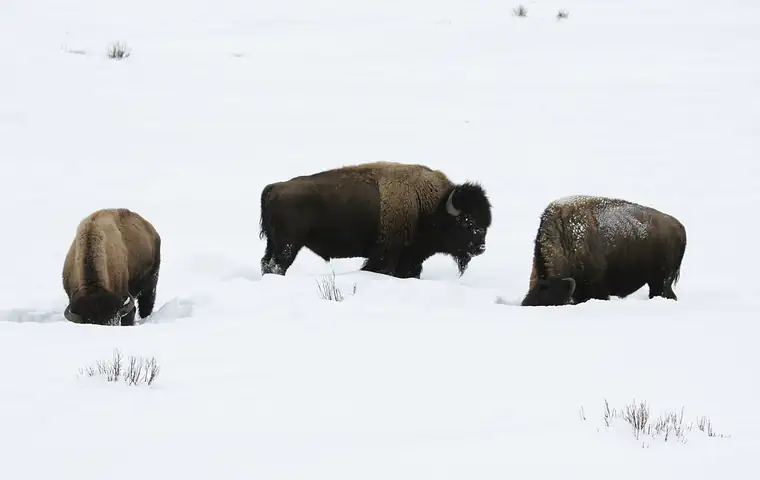
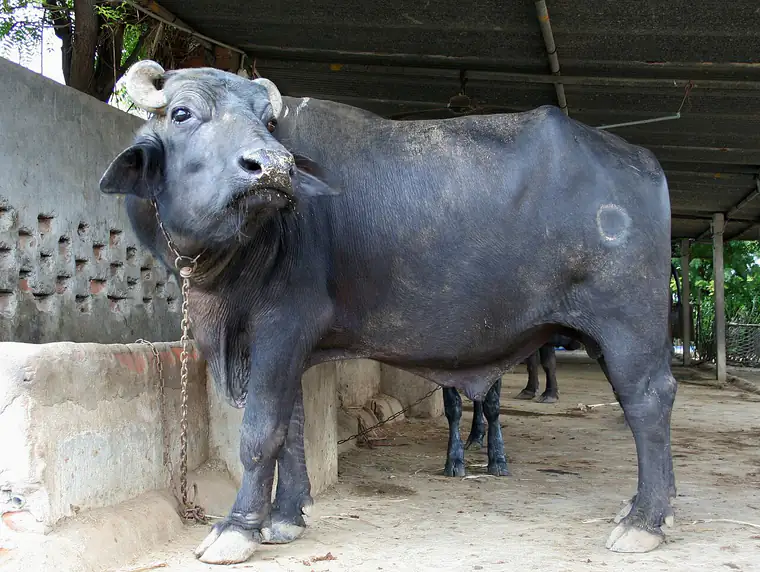
Bison and Plains Indian Nations
The relationship between American bison and the Indigenous peoples of the Great Plains is one of the most extensively studied human-animal relationships in North America. For the Lakota (Sioux), Blackfoot, Comanche, Crow, Cheyenne, Arapaho, Kiowa, and many other nations, the bison was not merely a food resource but the organising principle of culture, economy, religion, and social structure.
A single Plains Indian family required an estimated 6-10 bison per year to meet basic needs. Virtually every part of the animal was used:
- Meat: eaten fresh, dried as pemmican, or stored frozen in winter
- Hide: tipi covers (a single tipi required 10-12 hides), robes, moccasins, shields
- Bones: tools, knives, sleds, children's toys
- Sinew: bowstrings, thread
- Stomach and bladder: cooking vessels, water carriers
- Tongue: considered a delicacy and used ceremonially
- Dung (dried buffalo chips): fuel in the treeless grasslands
- Hair: stuffing, cordage
- Horns: cups, spoons, headdress elements
This total-use relationship was accompanied by deep spiritual significance. In Lakota theology, the White Buffalo Calf Woman, a spiritual being who came to the Lakota people and gave them the Sacred Pipe, is associated with the white buffalo (an exceedingly rare albino or leucistic bison calf, with perhaps a 1-in-10 million chance of occurring naturally). The birth of a white buffalo is considered a sacred sign by many Lakota people, and several such births in the late 20th and early 21st centuries generated significant ceremonial gatherings.
The Sun Dance ceremony, central to many Plains Indian spiritual traditions, often involved bison symbolism; bison skulls were placed on altars or hung in ceremonial contexts. Pre-hunt ceremonies included prayers and protocols for respectfully taking the animals. The Lakota concept of Mitakuye Oyasin ("all my relatives" or "we are all related") frames the relationship with bison not as predator-prey but as a covenant between peoples sharing the Earth.
Hunting Technology and the Jump Kill
Before the introduction of the horse to the Great Plains (horses spread northward from Spanish colonial settlements in New Mexico from the mid-1600s), Plains nations used sophisticated communal hunting techniques. The most dramatic was the buffalo jump, or piskun in Blackfoot: herds were driven by runners and noise-makers to the edge of a cliff, where they fell to their deaths. Parties waiting below processed the carcasses.
Head-Smashed-In Buffalo Jump in Alberta, Canada (a UNESCO World Heritage Site) shows evidence of continuous use for at least 6,000 years. The "head-smashed-in" name refers to a legend of a young Blackfoot man who was crushed by falling bison while sheltering at the base of the cliff.
After the horse spread to the Plains in the 1700s, mounted hunting became the dominant technique and enabled unprecedented hunting efficiency, which, combined with the commercial hide trade, would ultimately lead to the species' near-extinction.
The Slaughter and Its Cultural Impact
The deliberate elimination of bison in the 1870s-1880s was understood by American military commanders as a strategy of cultural destruction. Without bison, Plains nations could not maintain their traditional way of life; they became dependent on reservation rations and were forced into agricultural labour and Christian schooling. The connection between bison elimination and the forcible assimilation of Indigenous peoples is explicitly stated in contemporary military and political documents.
This history gives the modern bison restoration movement a dimension that goes beyond wildlife conservation. For many Plains nations, the return of bison to tribal lands is an act of cultural reclamation and sovereignty. The InterTribal Buffalo Council, founded in 1992 and supported by 70+ tribes, manages over 20,000 bison on approximately 1 million acres of tribal land across 19 states. Their stated mission explicitly connects bison restoration to tribal cultural revitalisation, youth education, traditional ceremonial practices, and food sovereignty.
A Note on the Word "Buffalo"
Read much about this animal online and you will be told that "buffalo" is a mistake. It is worth pausing on that, because the InterTribal Buffalo Council chose the word for its own name, and so did the Buffalo Treaty signed in 2014 by nations on both sides of the Canada and United States border. Across Indian Country the English word in everyday use, in ceremony, in restoration programmes and in tribal enterprise, is very often buffalo.
Those are not people who have failed to keep up with taxonomy. "Buffalo" entered English for this animal in the 1600s, generations before the genus Bison existed, and it is the word that carried through the treaty era, the near-extermination and the return. It holds a history that "bison" does not. Where a nation uses buffalo, that is the word for the animal, and the scientific name has no standing to overrule it.
None of that makes "bison" wrong either. It is the precise term, and it is the one to use with a biologist or with anyone outside North America, where buffalo means the cape buffalo or the water buffalo. This site uses "bison" for clarity when it is comparing species and "buffalo" where the context calls for it. See the etymology page for the full sequence of dates.
Bison in American National Identity
The American bison occupies a paradoxical role in US national symbolism: an animal nearly exterminated by the nation now claimed as its national mammal. The bison appears on the seal of the Department of the Interior, the Kansas state flag, the Wyoming state flag, the coat of arms of Oklahoma, and the Great Seal of the United States (historically, before the eagle became dominant). Place names from Buffalo, New York to Bismarck, North Dakota (from "Bison" via French derivation) carry the animal's legacy.
The Buffalo Soldiers, African American cavalry and infantry regiments of the US Army active from 1866 to 1944, were reportedly named by Plains Indian peoples they fought, who likened their curly hair to the bison's mane. The regiments adopted the bison as their symbol, wearing the image on their regimental seal. The Buffalo Soldiers' history is a further illustration of how deeply the bison was woven into 19th-century American cultural consciousness, even as the animal was being eliminated from the landscape.
Water Buffalo in Asian Culture
The water buffalo's cultural significance in Asia derives from its role as the foundational draft animal of wet rice agriculture, the system that fed the majority of Asia's population for approximately 5,000 years. In Vietnam, Thailand, Cambodia, Laos, the Philippines, southern China, India, Nepal, and across South and Southeast Asia, the water buffalo (known as carabao in the Philippines, trau in Vietnamese,kwai in Thai, bhainsi in Nepali) is inseparable from the agricultural landscape.
In Vietnamese culture, the water buffalo is a symbol of rural life, hard work, and endurance. Traditional folk poetry frequently references the buffalo working in the rice paddies at dawn. In Balinese Hinduism, the buffalo is associated with certain ritual practices. In the Philippines, the carabao is the national animal; Carabao Day (May 14) is a public holiday in rural areas of Pampanga.
Yak butter and yak-based products are culturally central in Tibetan culture (the yak is technically not a buffalo but a Bos species), illustrating how different bovids serve parallel cultural functions across Asia's ecological zones.
Cape Buffalo in African Culture and Mythology
The cape buffalo's cultural role in Africa is complex and varies significantly by region and tradition. In many East and Southern African cultures, the buffalo represents strength, unpredictability, and danger. Hunting a cape buffalo alone on foot was a test of manhood in certain pastoral and hunter-gatherer traditions.
In colonial trophy hunting culture, the cape buffalo's legendary toughness and tendency to charge when wounded made it the ultimate test of a hunter's nerve. This reputation was amplified by writers including Hemingway, Robert Ruark, and John Hunter, who wrote extensively about their buffalo hunting experiences in East Africa. The resulting mystique contributed to both the romantic colonial safari culture and, more problematically, to trophy hunting economics that persist today.
In post-colonial Africa, attitudes toward the cape buffalo are more varied: as a keystone prey species for lions and other predators in national parks, they are central to the ecological story marketed to wildlife tourists; as a disease reservoir near cattle ranching communities, they are sometimes resented and feared in a more practical sense.