How Closely Related Are They?
Both bison and domestic cattle belong to the tribe Bovini within the family Bovidae. Domestic cattle (Bos taurus, the taurine or hump-less cow, and Bos indicus, the zebu) share the genus Bos with yaks, gaurs, banteng, and kouprey, while bison sit in the closely related genus Bison.
Genetic analysis places the divergence of the Bison and Bos lineages at approximately 1-2 million years ago (some estimates push it to 2.5 million years). This is recent enough that the two can produce viable, fertile hybrid offspring, unlike, for example, a horse and a donkey (whose hybrids are sterile). The bison-cattle hybrid, variously called beefalo, cattalo, or wood bison hybrid, was actively pursued by 19th and early 20th century ranchers hoping to combine bison hardiness with cattle docility.
Bison and cape buffalo, by contrast, last shared a common ancestor approximately 5-9 million years ago and are reproductively incompatible.
Side-by-Side Comparison
| Trait | Bison | Domestic Cow |
|---|---|---|
| Scientific name | Bison bison | Bos taurus / Bos indicus |
| Genus | Bison | Bos |
| Tribe | Bovini | Bovini (same tribe) |
| Domesticated? | No (farm-managed, not domestic) | Yes (10,000+ years) |
| Shoulder hump | Pronounced muscular hump | None (zebu/brahman cattle have fat hump) |
| Forehead wool | Thick curly wool and beard | Short hair, no mane or beard |
| Adult bull weight | 630-1,000 kg | 450-1,100 kg (breed dependent) |
| Speed | 55-60 km/h | 24-40 km/h (breed dependent) |
| Temperament | Wild, unpredictable | Domesticated, manageable |
| Can interbreed? | Yes (produces beefalo/cattalo) | Yes (hybrids mostly fertile) |
| Chromosome count | 60 chromosomes | 60 chromosomes |
| Lifespan (wild/range) | 15-20 years | 15-20 years |
| IUCN status | Near Threatened | Not assessed (domestic) |
Why Bison Were Never Domesticated
Given how closely related bison and cattle are, it is a natural question: why were cattle domesticated 10,000 years ago but bison were not? The answer lies in a combination of geography, behaviour, and historical contingency.
The ancestors of domestic cattle, the aurochs (Bos primigenius), were domesticated in the Near East and possibly independently in South Asia around 10,000 BCE. The humans doing the domesticating were Neolithic farmers in a zone with a long history of plant and animal exploitation. Bison, by contrast, lived in North America, where the people who relied on them, Plains Indian nations, developed highly sophisticated hunting cultures centred on following the herds, not confining them.
Bison are also behaviourally resistant to confinement. They are capable of jumping 1.8 metres (6 feet) from a standing start, can outrun a horse over short distances, and maintain what can only be described as a wild temperament even after generations of ranch-raised existence. Modern bison farms exist (bison meat is commercially available in the US and Canada) but they require much heavier fencing and more careful handling than cattle operations of comparable size. Bison ranching is not "domestication" in the technical sense: the animals are not tame and have not been selectively bred over thousands of generations for docility.
The Beefalo: When Bison and Cattle Merge
The beefalo, a stable bison-cattle hybrid, is a commercially recognised livestock category in the United States. The American Beefalo Association (founded 1974) defines "full blood" beefalo as 3/8 American bison and 5/8 domestic bovine. Beefalo have been selected for meat characteristics combining the leanness of bison with the docility and growth rate of cattle.
Beefalo meat is commercially available at specialty butchers and some supermarkets in North America. It is leaner than beef (typically 2-3% fat vs 5-20% fat in beef cattle breeds), higher in protein, and marketed as more environmentally sustainable due to lower methane emissions per kilogram of meat produced.
Early 20th century experiments in producing beefalo were largely unsuccessful because the hybrid bulls were infertile (a phenomenon called hybrid dysgenesis). The breakthrough came when breeders found that backcrossing female hybrids (who retained fertility) to male cattle over multiple generations produced a stable fertile line. Modern beefalo are fully fertile through male and female lines.
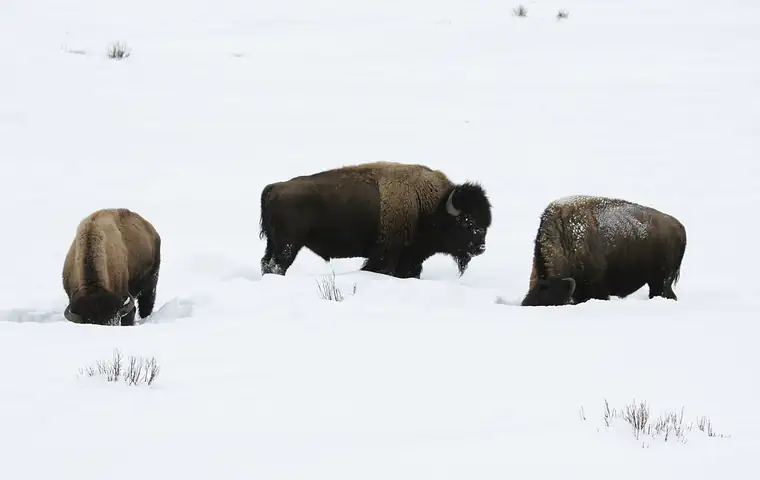
Visual Identification: Bison vs Cattle
In a field context, distinguishing a bison from a domestic cow or bull is straightforward:
- Bison have a very prominent muscular hump over the front shoulders; cattle do not (except zebu/Brahman, whose hump is a fat deposit further forward).
- Bison have a thick shaggy mane and beard on the front of the body; cattle do not.
- Bison are significantly more massive across the front shoulder than the hindquarter; cattle have a more uniform body profile.
- Bison carry their head much lower, often at or below shoulder height, than cattle at rest.
- Bison horns are short and strongly upward-curved; cattle breeds have highly variable horn shapes, but none develop the same combination of short, upward-curving horns on such a massive skull as the bison.
The confusion between bison and cattle is most likely to occur with beefalo (which may show intermediate characteristics) or with large zebu-cross breeds in North America. In all cases, the presence or absence of the massive forequarter hump and shaggy mane is the fastest identifier.