Taxonomy and Subspecies
The cape buffalo (Syncerus caffer) belongs to genus Syncerus, which contains only this single species. Four subspecies are recognised:
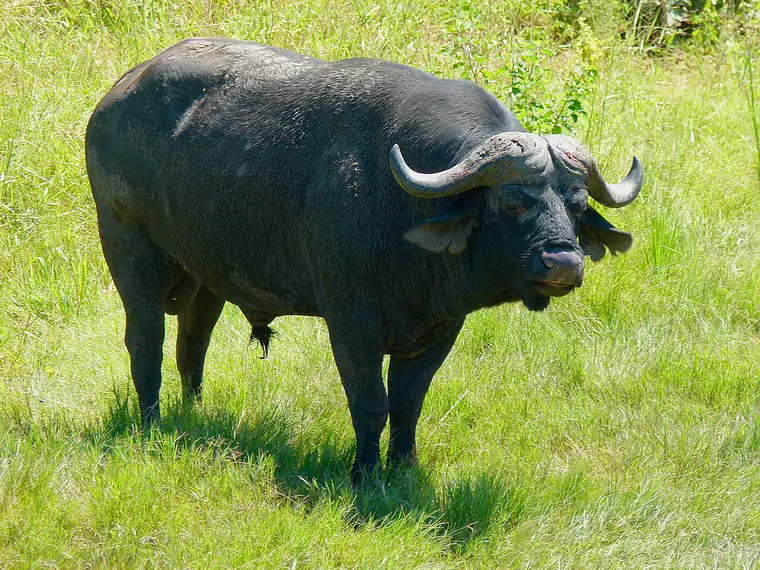
- Cape buffalo (S. c. caffer): The nominate subspecies, largest and most numerous. Found across eastern and southern Africa from Ethiopia to the Cape. Adult bulls average 700-900 kg; exceptional animals can reach 1,000 kg. The classic heavy-bossed horns of popular imagination belong to this subspecies.
- Forest buffalo or Congo buffalo (S. c. nanus): Considerably smaller (160-320 kg), reddish-brown in colour rather than black, with smaller, less swept horns. Found in the dense rainforests of West and Central Africa. This subspecies looks so different from the cape buffalo that they are sometimes treated as separate species; genetic evidence confirms they diverged but maintains subspecific status.
- Sudan buffalo (S. c. brachyceros): Intermediate in size and horn shape between the two above. Found in West Africa north of the forest zone.
- Nile buffalo (S. c. aequinoctialis): Found in East Africa. Also intermediate in size; classification contested.
Physical Characteristics
Adult male cape buffalo (nominate subspecies) stand 140-150 cm (4.5-5 feet) at the shoulder and weigh 500-900 kg (1,100-2,000 lb), with extreme individuals approaching 1,000 kg. Females are considerably lighter at 300-500 kg. Body length ranges from 170 to 340 cm.
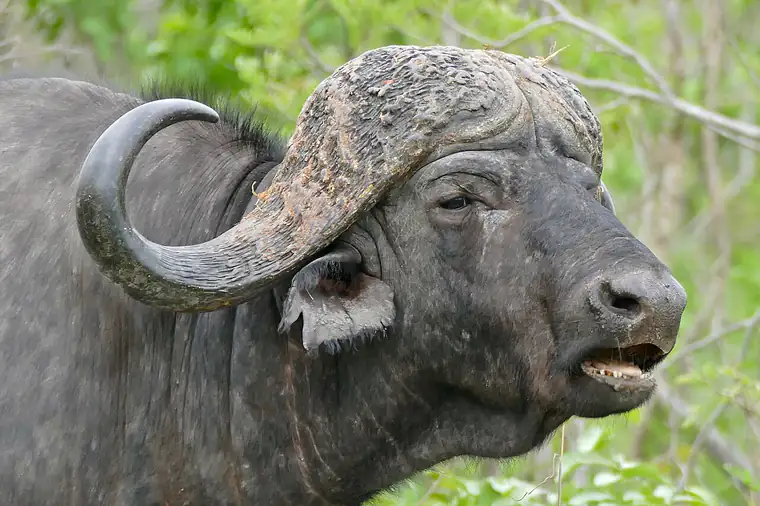
The defining anatomical feature of the cape buffalo is the horn boss, the fused shield of bone and horn keratin that forms a continuous plate across the top of an adult bull's skull. This boss develops gradually and is complete by age 7-8; its presence is the primary way to assess age and sex in the field. The boss of a mature bull can be 50 mm thick at the midline, making a frontal headshot with a large-calibre rifle one of the least reliable stopping shots in African hunting: the bullet may fail to penetrate the boss.
From the boss, the horns sweep downward and outward, then curve upward and inward at the tips. Tip-to-tip spreads of 100-140 cm are common in large bulls; record specimens measured by the Rowland Ward trophy record system have exceeded 160 cm. Females have smaller, lighter horns that do not develop the fused boss.
The coat is short and sparse, dark charcoal grey to black in adults; calves are reddish-brown. Old bulls lose hair progressively and their skin shows prominently. Cape buffalo have large, broad hooves well-suited to soft ground and are competent swimmers.
The "Big Five" and Why Cape Buffalo Are Considered Dangerous
The "Big Five" (lion, leopard, elephant, rhinoceros, and cape buffalo) is a term coined by 19th-century sport hunters to describe the five most difficult and dangerous animals to hunt on foot in Africa. The cape buffalo was included not because of its size (elephants are heavier) but because of its behaviour when wounded or cornered.
Cape buffalo have a well-documented tendency to double back and ambush pursuers when wounded, a behaviour that made them particularly feared by hunters using the lower-powered rifles of the colonial era. They have been credited with killing more big-game hunters than any other African species, a claim that is difficult to verify statistically but is consistent with historical hunting literature. Ernest Hemingway wrote extensively about the species in "Green Hills of Africa" and "The Short Happy Life of Francis Macomber."
More broadly, cape buffalo are considered dangerous because they are unpredictable in groups: a herd of several hundred can move suddenly and collectively, and lone old bulls (called "dagga boys" from the Zulu/Nguni word for mud, reflecting their wallowing habit) are particularly associated with aggressive encounters with humans and other predators.
It is important to note that "most dangerous" is contextual. Cape buffalo are not ambush predators. Their danger to humans arises specifically from close encounters, usually while hunting or when inadvertently cut off from escape. In a wildlife watching context, with appropriate distance, they are no more inherently dangerous than a herd of cattle.
Ecology and Behaviour
Cape buffalo are highly social grazers and browsers. Large mixed herds of 100-1,000 animals are typical in prime habitat; they forage mainly at night and in the early morning, resting during the heat of the day. They are dependent on water and rarely move more than 15-20 km from a permanent water source in dry seasons.
Buffalo are important prey for lions and crocodiles. Encounters between large lion prides and buffalo herds are among the most dramatic wildlife spectacles on the continent; a herd will often mob lions that kill one of their number, sometimes successfully rescuing the prey. The famous "Battle at Kruger" video, filmed at Kruger National Park in 2004 and viewed over 100 million times on YouTube, shows a herd of buffalo rescuing a calf from lions and crocodiles.
Gestation is approximately 340 days; calves are born singly, most frequently between January and April in Southern Africa. Lifespan is 15-25 years in the wild; up to 29 years in captivity.
Conservation Status and Population
The cape buffalo (nominate subspecies and overall species) is listed as Near Threatened on the IUCN Red List (assessed 2018, published 2019; IUCN SSC Antelope Specialist Group), with an estimated population of around 400,000 individuals and a decreasing trend. It was reassessed from Least Concern, its 2008 listing, to reflect range-wide declines. The species is still widespread across sub-Saharan Africa and is well-represented in protected areas including Serengeti, Masai Mara, Kruger, Hwange, and Kafue.
However, the IUCN notes a declining trend and significant threats: disease (particularly foot-and-mouth disease and bovine tuberculosis, which have caused major declines in the Kruger National Park population); habitat loss and fragmentation; bush meat hunting; and conflicts with livestock around protected area boundaries.
The forest buffalo subspecies (S. c. nanus) faces more severe pressures; it is hunted heavily for bushmeat in Central and West Africa, and its rainforest habitat is among the most rapidly deforested biomes on Earth. Some authorities argue it deserves a higher-threat IUCN category if assessed separately.
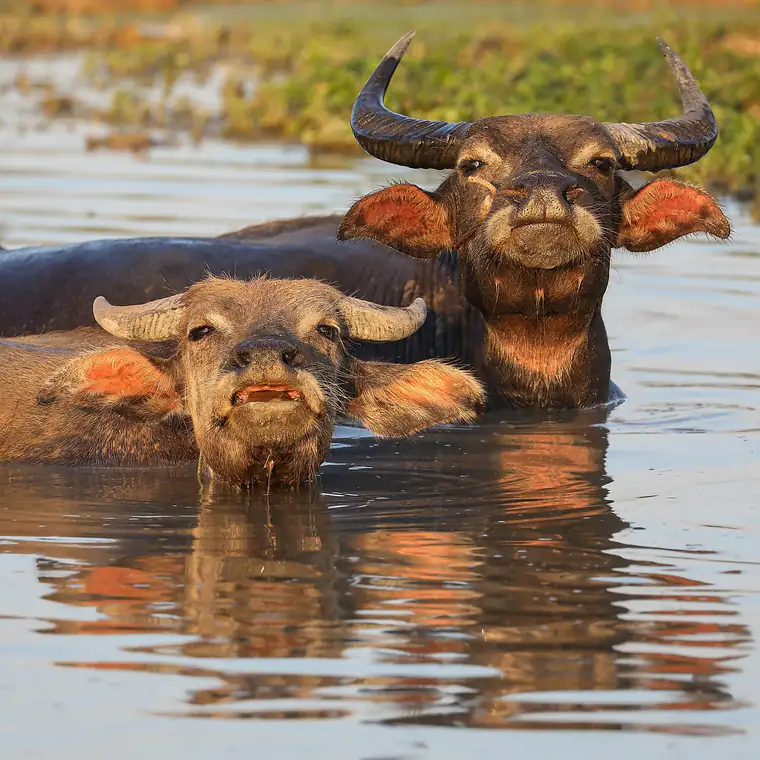
Cape buffalo cannot be domesticated: unlike water buffalo, they have never been successfully tamed. Attempts to farm them commercially exist but are limited to high-fenced game ranches in South Africa, where they are managed as wildlife assets for trophy hunting and photo safaris rather than as agricultural livestock.