Are bison bigger than elk?
Yes, and by a wide margin. A bull bison weighs 700 to 900 kg, with exceptional and wood bison bulls reaching about 1,000 kg or more. A bull elk weighs about 315 kg (700 lb), with the largest bulls anywhere approaching 450 kg (1,000 lb). That makes a bull bison two to three times the mass of a bull elk. The bison is also taller at the shoulder, 1.6 to 1.85 m against roughly 1.5 m for elk. The only measure on which the elk looks bigger is total standing height, because a bull elk carries its head high and its antlers can sweep well above 2.5 m off the ground, but that is reach, not mass. On weight and on shoulder height the bison is the larger animal.
Headline numbers
| Trait | American bison (Bison bison) | Elk / wapiti (Cervus canadensis) |
|---|---|---|
| Family | Bovidae (cattle family) | Cervidae (deer family) |
| Bull weight | 700-900 kg (peak ~1,000+) | ~315 kg / 700 lb (peak ~450 kg) |
| Cow weight | 360-544 kg | ~225 kg / 500 lb |
| Shoulder height (bull) | 1.6-1.85 m | ~1.5 m |
| Head ornament | Horns (permanent, both sexes) | Antlers (annual, bulls only) |
| Coat | Shaggy dark brown, shoulder hump | Tan body, dark neck mane, pale rump patch |
| Diet | Grass grazer (~90% grass) | Mixed grazer-browser (grass, shrubs, forbs) |
| Voice in rut | Deep bellow | High bugle |
| Yellowstone (summer) | ~5,000 | 10,000-20,000 (seven herds) |
Elk measurements from the National Park Service (Rocky Mountain elk). Bison figures use the site-wide reference ranges also cited on the size and weight page.
The elk naming confusion
This site exists because English gives two animals one name, bison and buffalo. The word elk has the same problem, and it is worth untangling before going further because it changes what animal a reader pictures.
In North America, elk means the wapiti, Cervus canadensis: a large tan deer, second in size only to the moose among the world's deer, with a bull's sweeping, many-tined antlers and a loud bugling call in autumn. In Europe, elk means an entirely different and much larger animal, Alces alces, the species North Americans call the moose. So when a European reads about American elk they are picturing a moose, and when a North American reads a European wildlife book that mentions elk they are picturing the wrong deer. To sidestep the tangle, the North American elk is also called the wapiti, from a Shawnee and Cree word meaning white rump, a reference to the animal's pale rump patch. Throughout this page, elk means the wapiti, Cervus canadensis.
None of this touches the bison, which is a bovid and not a deer at all. But the two confusions rhyme: a single English word doing duty for two different animals, resolved only by naming the species precisely.
Horns vs antlers: permanent vs annual
The clearest structural difference between a bison and an elk is on the head. The bison carries horns; the elk carries antlers. They look different and they grow in completely different ways.
Horns are permanent. They are a bony core growing from the skull, sheathed in keratin, the same material as hair and fingernails. Both sexes of bison carry horns, they are present year-round, and they grow slowly throughout life so that an old bull's horns are larger than a young bull's. A damaged horn does not regrow. Bison horns are short, sharp, and curved, and are used for defence and for shoving contests in the rut.
Antlers are temporary. They are pure bone, not keratin-sheathed, grown from a pedicel on the skull and shed and regrown every year. Only bull elk carry them. A bull grows a fresh set through spring and summer under a skin of blood-rich velvet, which is rubbed off in late summer as the antler hardens for the autumn rut. A mature bull's antlers can span more than a metre and, according to the Rocky Mountain Elk Foundation, weigh up to about 18 kg (40 lb) for the pair. The set is carried through the rut and shed in late winter, leaving the bull antler-less until the cycle starts again. That annual shed is why elk antlers, not bison horns, are the ones collected in sheds and sold at antler markets.
Telling them apart at a glance
In the field the two are hard to confuse once you know the cues, which is exactly why they are so often confused by first-time visitors who do not. The bison is a massive, front-heavy, dark-brown animal with a pronounced shoulder hump, a thick beard and cape of shaggy hair over the head and forequarters, and short curved horns on both sexes. The silhouette is unmistakable even at distance: weight carried forward, head held low.
The elk is a tan-bodied deer with a darker brown neck and legs, a conspicuous pale cream rump patch, no hump, and a lighter, more balanced build that carries its head high. A bull in autumn carries large branching antlers; a cow and a young animal carry none, which is where confusion with other deer, rather than with bison, tends to arise. No elk, of either sex, has a shoulder hump or the bison's shaggy dark cape.
Diet: overlap without direct competition
Both animals eat plants, and in Yellowstone they graze the same valleys, but their diets diverge enough to keep competition limited. The bison is a specialist grass grazer, taking around 90 per cent of its diet from grasses and sedges and moving across open grassland in large herds to find it. The elk is a generalist mixed feeder: it grazes grass heavily in spring and summer, when new growth is richest, then shifts in autumn and winter to browsing the twigs, bark, and buds of aspen, willow, and conifer, plus forbs and shrubs.
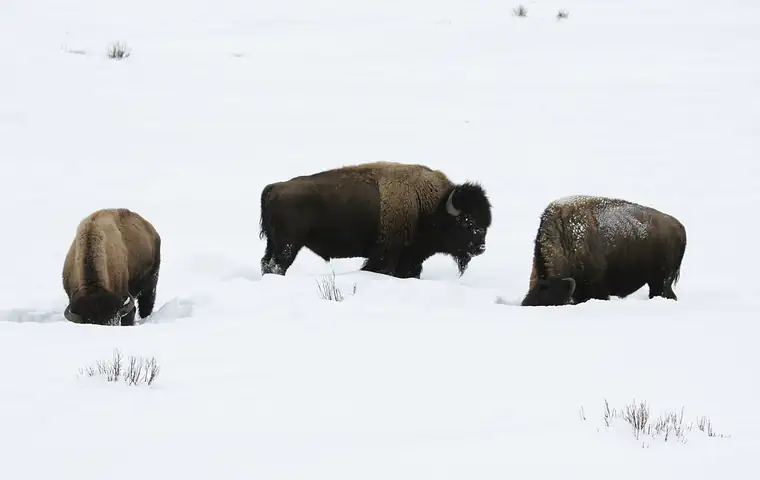
That flexibility is the key ecological difference. An elk can make a living in forest, shrubland, and mountain meadow that a grass-dependent bison largely avoids, which lets the two species share a landscape while using different parts of it. In hard winters the distinction sharpens: bison bulldoze snow off grass with sweeps of the head, while elk move to browse and to wind-scoured slopes.
Both together in Yellowstone
Yellowstone National Park is the one place where a visitor is almost guaranteed to see bison and elk on the same day, which is also why the two are so often mixed up in trip photos and captions. The National Park Service estimates that 10,000 to 20,000 elk spend the summer in the park across seven herds, far outnumbering the roughly 5,000 bison.
The two are usually found in different parts of the park. Bison concentrate in the open grassland of the Lamar and Hayden valleys, moving in herds of tens to hundreds. Elk are most reliably seen around Mammoth Hot Springs, where cow herds graze the lawns beneath the historic buildings, and across the northern range. In autumn the bull elk rut brings bugling and sparring into full view around Mammoth, while the bison rut peaks earlier, in July and August, with bellowing and wallowing in the valleys. Both species injure visitors who approach too closely every year, and the park's 25-yard minimum distance applies to each.
Frequently asked questions
Is an elk a type of buffalo or bison?
No. An elk is a deer (family Cervidae). A bison is a bovid (family Bovidae), the same family as cattle and true buffalo. Elk and bison are not close relatives and the elk is not a kind of buffalo, a kind of bison, or a kind of cattle. The only thing they share is a habitat.
Why is the North American elk also called a wapiti?
Because elk already meant a different animal in Europe, the moose. Early naturalists and later biologists adopted the Indigenous name wapiti, from a Shawnee and Cree word for white rump, to name Cervus canadensis unambiguously. Both names are correct in North America; wapiti is the one that avoids being misread by a European audience.
If a bison and an elk fought, which would win?
The question is not biologically meaningful, since the two do not compete and do not fight one another, but the mass difference is decisive: a bull bison is two to three times the weight of a bull elk. In practice neither animal seeks a confrontation with the other, and an elk faced with a bison simply moves away.
Where else can both be seen together?
Grand Teton National Park, immediately south of Yellowstone, holds both species, with a large elk herd that winters on the National Elk Refuge near Jackson and a growing bison herd. Elsewhere in the mountain west and the northern plains the two ranges overlap in places such as Wind Cave and Custer State Park in South Dakota, where a visitor can see plains bison and elk within the same reserve.